
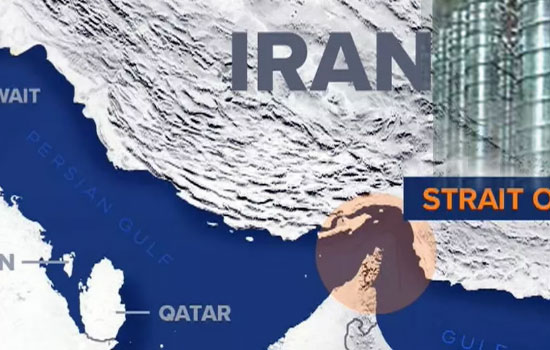
Why are enrichment and the Strait of Hormuz important?
Javid Shirazi
Supermarket keys always discount Iran!
(By:Akhbaremali- (Financial news
Publication Date: 2026
Introduction
The US-Israeli war on Iran marks the culmination of four decades of Iranian efforts to lift sanctions. Efforts that included negotiations, deals, regional de-escalation, and limited economic cooperation, yet in practice yielded nothing but the return of sanctions in more complex, broader, and more persistent forms.
This historical experience shows that sanctions, contrary to common belief, are not a temporary pressure or tactical tool; rather, they are a geoeconomic architecture designed to create a lasting restrictive structure to control Iran’s economic and political capacity.
Richard Nephew, one of the key architects of Iran sanctions, explains in The Art of Sanctions that the goal is to “inflict pain” and “erode endurance.” His logic is clear: sanctions must prevent leverage-building and keep the target country from developing independent bargaining power.
The Geoeconomic Cage: A New Metaphor for Sanctions
In this article, to better explain this structure, we use the metaphor of the “Geoeconomic Cage” — a metaphor showing that sanctions are designed not for momentary pressure but for long-term containment.
This same logic explains why the US and Israel have focused all their efforts on shutting down enrichment and removing enriched uranium from Iran, rather than on opening the Strait of Hormuz or regime change, which they initially claimed to pursue.
Inside the cage, conventional tools of power — oil, gas, trade, diplomacy, agreements — are either sanctionable or quickly neutralized. The recent war on Iran, following years of experience, has shown that the country needs a shift in the balance of power to unlock the cage, and that it has room to maneuver in only two areas that are not sanctionable.
Sanctions as a Control System
US sanctions since the 1990s have evolved from a pressure tool into a stable economic control system pursuing three main objectives:
- Preventing Iran’s access to global capital
- Preventing access to key technologies
- Preventing the formation of any counter-leverage
For this reason, every time Iran has tried to reduce sanctions through conventional means — negotiations, de-escalation, or economic cooperation — the result has been the return of sanctions at a higher level. Nephew emphasizes that “sanctions are designed to be quickly reinstated even after an agreement.”
The Western Coalition Behind the Cage
In designing and implementing this geoeconomic cage, the US is not the sole player. Europe and the UK play a complementary but vital role — from designing financial and banking sanction mechanisms (like SWIFT, INSTEX, and cutting insurance and shipping ties) to pressuring neighboring countries to avoid economic cooperation with Iran.
Contrary to popular belief, Europe has never sought to break the cage; rather, it has always tried to keep the cage “managed” to avoid the security consequences of its collapse (such as migration, terrorism, and regional escalation). The UK, post-Brexit, has followed US sanction architecture, sometimes even more strictly.
Thus, the sanctions cage was designed and consolidated not by two players (the US and Israel) but by a Western coalition; any shift in the balance of power requires changing the calculations of all of them.
The Mandatory Supermarket: The Cage in Action
The sanctions cage has turned Iran’s economy into a permanently discounted supermarket for small and large customers worldwide — an economy that, to maintain minimal exports, is forced to pay hidden subsidies to foreign customers by exploiting domestic resources (water, energy, raw materials, and human capital).
Whenever Iran tries to distance itself from this position, it faces crises such as:
– Widespread unemployment
– Spiraling inflation
– Volatile exchange rates
– Food and commodity insecurity
In such a structure, no sanctionable economic or diplomatic tool can shift the balance of power.
The sanctioned economy also transforms domestic architecture. To compensate for external constraints, the government is forced to suppress prices, maintain multiple exchange rates, provide heavily subsidized energy, and use domestic resources to compensate for the lack of foreign capital.
This creates a fragile, unstable economy — one where any major reform, in the absence of exchange rate stability, foreign capital, and modern technology, turns into a crisis rather than an improvement. Sanctions have left the economy without shock absorbers: no foreign capital, no exchange stability, and no public trust.
Non-Sanctionable Levers: Enrichment and the Strait of Hormuz
To unlock this invisible but highly resilient cage, a shift in the balance of power is essential. Without this shift, no player will willingly forgo the benefits they gain from continuing to buy from Iran’s ever-discounted supermarket.
The dual policies of Russia and China — countries with long-term strategic cooperation agreements with Iran — as well as regional rivals like Turkey and Saudi Arabia, and other nations such as India, Malaysia, South Korea, and others in fundamental issues with Iran, stem from this very approach.
But Iran now has two levers that sanctions cannot zero out.
First Lever: Uranium Enrichment
Enrichment is a technology that has been indigenized in Iran, is irreversible (or reversing it would be prohibitively expensive), and can impose real costs on the other side. These features have turned enrichment from a technical issue into a geoeconomic variable.
According to official IAEA reports in 2026, Iran possesses approximately 440.9 kg of 60% enriched uranium — enough, if further enriched, for approximately 10 potential nuclear weapons.
Most of this stockpile is reportedly stored in underground facilities in Isfahan, and the IAEA has confirmed that the exact location of some of it is unknown. This uncertainty itself has become a deterrent lever.
> Key Insight: For the US and Israel, the main issue is not Iran’s “nuclear program” but its effect — i.e., its geoeconomic leverage.
Sixty-percent enriched uranium is the point at which:
– Breakout time is reduced to a few weeks
– Potential deterrence is created
– Sanctions turn from a “pressure tool” into a “crisis management tool”
– The cage structure becomes destabilized
This is why the US and Israel insist so strongly on halting enrichment — not for security reasons, but to preserve the power structure and maintain control over limiting Iran’s economic capacity in the years ahead.
Second Lever: The Strait of Hormuz
It has now been proven that given Tehran’s ability to effectively manage the Strait of Hormuz, this geographical location is not a “complementary” or “sanctionable” lever for Iran, but rather a lever of equal weight and parallel to enrichment.
Key Facts:
– About one-third of global oil trade passes through this strait
– Any disruption can quickly raise energy prices worldwide
– The US claims “the Strait of Hormuz does not matter to us” (oil imports through the strait are nearly zero), but this is more political stance than economic reality
Why alternative routes are insufficient:
– Alternative pipelines (Saudi Arabia and UAE) lack sufficient capacity
– Replacement costs would be tens of billions of dollars over many years
– In wartime, “bypassable” does not mean “bypassed in practice”
The US objective in targeting Iran’s naval power has been to reduce Iran’s control over the strait as a bargaining lever — yet the current state of the strait shows this goal has not been achieved.
Key Point: The Strait of Hormuz gains more meaning alongside enrichment. The combination of these two levers is what can unlock the geoeconomic cage.
The Costs and Limitations of Leverage-Building
Having leverage does not mean the leverage is effective. To be effective, the other side must believe that Iran has the will and ability to use it.
This belief can carry heavy domestic costs, including:
– Intensified sanctions and greater isolation
– Capital and brain drain (estimated at $10–15 billion annually in human and financial capital)
– Reduced capacity to attract investment even in the event of a possible agreement
– Domestic political and security pressures
The Digital Dollar Challenge
In addition, the digital dollar and the transformation of the global financial system complicate the equation far more than many common analyses assume. The US is designing a digital currency that can track, limit, or block dollar transactions in real time.
In such a world, “circumventing sanctions” will be much harder than in the past. This strategic shift must not be ignored.
Can Iran Bear These Costs?
The experience of the past four decades shows that Iranian society has a high capacity for resilience against external pressure, but this capacity is not unlimited.
Intensified sanctions, combined with capital and brain drain, gradually erode social capital and hope for the future. Any major step in leverage-building (such as moving toward higher enrichment or tightening control over the strait) could, through rapid retaliation, raise pressures to a level where “shock absorption” is no longer possible.
> Warning: The experience of gasoline price reform and the subsequent nationwide protests is a reminder that even correct economic reforms under sanctions can turn into social crises.
Therefore, the costs of leverage-building should not be viewed merely numerically and economically; the “price of lost public trust and social capital” must also be factored into calculations.
For Iran to move down this path, it needs not only political will but also management of domestic expectations and fair distribution of costs. Otherwise, leverage-building may weaken national cohesion rather than strengthen it.
Unlocking the Cage, Not Leaving It
Do Iran’s levers unlock the cage? Yes, but this does not mean leaving the cage.
Unlocking means:
– The US is forced to manage risk
– Europe is forced to open limited channels of engagement
– China and India strengthen Iran’s economic role
– Limited, conditional foreign investment becomes possible
But the cage remains in place. Core sanctions (financial, technological, missile, arms) remain fully in effect.
Key Distinction: “Unlocking” does not mean the end of sanctions; it means a change in the type of sanctions — from crippling sanctions to managed sanctions.
From this perspective, enrichment and maintaining control over the Strait of Hormuz are not tools of war for Iran; they are tools of geoeconomic bargaining.
In a structure where sanctions are designed for permanent containment, enrichment and control of the strait are the only domains that are:
– Not sanctionable
– Able to impose costs on the other side
– Capable of shifting the balance of power
Conclusion
Sanctions are an invisible cage.
Enrichment and the Strait of Hormuz are two levers that can unlock this cage for Iran. But unlocking does not mean leaving the cage. The cage remains in place; but from within it, Iran finds leverage for bargaining and gradually changing the equation.
If it loses this opportunity as well, it will waste away inside the sanctions cage.
The digital dollar and the transformation of the global financial system make this equation more complex than many common analyses assume.
This is why the US and Israel have focused all their efforts on:
– Halting enrichment
– Removing enriched uranium from Iran
– Reducing Iran’s control over the Strait of Hormuz
> Final Message: If any lever remains in Iran’s hands, the lock of the cage — built for Iran over nearly half a century — will be opened forever.
© 2026. All Rights Reserved.
برچسب ها :
ناموجود- نظرات ارسال شده توسط شما، پس از تایید توسط مدیران سایت منتشر خواهد شد.
- نظراتی که حاوی تهمت یا افترا باشد منتشر نخواهد شد.
- نظراتی که به غیر از زبان فارسی یا غیر مرتبط با خبر باشد منتشر نخواهد شد.

ارسال نظر شما
مجموع نظرات : 0 در انتظار بررسی : 0 انتشار یافته : 0